
Bioplast
Bioplast® is a medical-grade, biocompatible polymer developed in Austria in 1998 and still produced in Tyrol (formerly sold as PMFK until 2003). Bioplast® was trademarked by Steel and Silver.
Bioplast® is flexible, can cut-to-length and threaded any standard metal ball closures, it pairs well with SS316L or titanium. Because the material equilibrates to body temperature rather than ambient air, initial swelling is often reduced, which can support smoother healing for new piercings; it’s nickel-free to minimize allergy concerns.
It can be autoclave-sterilized and, when used without metal attachments, isn’t visible on X-rays. The Association of Professional Piercers (APP) considers it suitable for fresh piercings.
Enamel
Enamel resin, also called “epoxidic resin”, has various outstanding properties:
It is smooth, hard, chemically resistant, durable, scratch resistant, long-lasting color, easy-to-clean, and cannot burn. When it hardens, it creates a smooth, durable coating on metals.
Enamel is not paint, so it does not fade with UV light.
EO Sterilization
Ethylene oxide (EO) gas sterilization delivers a very high sterility assurance level and penetrates complex geometries exceptionally well. When piercing jewelry is EO-sterilized and stored in intact packaging away from light and moisture, it remains sterile for up to five years.
Before sterilization, every piece is thoroughly cleaned and quality-checked. We then package the jewelry unassembled so the post, balls, and-critically-the threads are fully exposed to the sterilant for complete coverage.
Each sterilization run is assigned a unique lot number, which appears on the product label. Lots are tested and documented; the corresponding reports are available for download below.
GOLD
Understanding Our Gold Jewelry
All our solid gold jewelry is made using 18 karat (750) gold or 14 karat (585) gold, offering you a choice between richer purity and everyday durability — both ideal for body jewelry. While pure 24 karat gold is too soft for piercings, both 18K and 14K gold offer excellent durability and elegance.
Note: Internal and Threadless pins are made with Gold Tubes.
What's the difference between 14K and 18K?
18K gold contains 75% pure gold (stamped “750”) — a richer, warmer color with a more luxurious look, preferred across Europe, the Middle East, and South Asia.
14K gold contains 58.5% pure gold (stamped “585”) — slightly harder due to higher alloy content, making it a touch more scratch-resistant. It's the everyday standard in North America, particularly the US.
Because 18K has more pure gold, it is softer — but for body jewelry worn in piercings (rather than rings or bracelets that take daily abrasion), this difference is minimal. Both are excellent choices for implant-grade body jewelry.
Pricing: 18K costs approximately 25–30% more than 14K for the same piece. With gold prices currently high, this gap is especially noticeable.
What sets us apart is the source of our gold :
We use pure gold refined by Morris and Watson, one of Australasia's largest and most respected gold refineries.
This company is globally trusted for its quality and ethical sourcing. www.morrisandwatson.com
To create 18K or 14K gold, we combine pure gold with other metals like silver, copper, or palladium.
This process - called alloying - gives the gold its color (yellow, rose, or white) and strength. Some customers may see “alloy materials” and worry there’s no real gold, but rest assured:
All our 18K gold items contain 75% pure gold — this is what “18K” or “750” stands for.
All our 14K gold items contain 58.5% pure gold — this is what “14K” or “585” stands for.
Both are laser-marked on each piece.
We also stamp our Swiss Responsibility Mark to guarantee authenticity and gold content.
Download "Verantwortlichkeitsmarke"
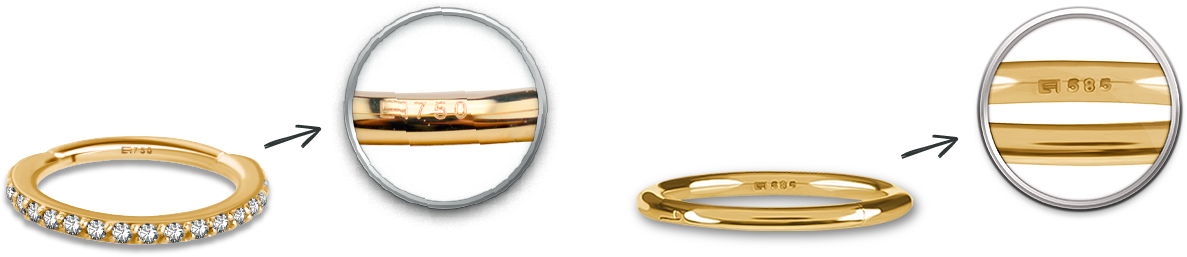
Our internal laboratory (ISO17025 certified) can create Gold composition certificates for specific products which are still with us.
Please send your request by email to [email protected].
Download "Sample Gold composition certificate"
Our Gold Standards
- G14K – Yellow Gold (585): Classic yellow tone, 14 karat
Yellow Gold 14K Alloy Data Sheet
Lead, Cadmium and Nickel Release Test for Yellow Gold 14K - G18K – Yellow Gold (750): Classic yellow tone, 18 karat
Yellow Gold Alloy Data Sheet
Lead, Cadmium and Nickel Release Test for Yellow Gold 18K - RG14K – Rose Gold (585): Warm pink hue from copper alloy, 14 karat
Lead, Cadmium and Nickel Release Test for Rose Gold 14K - RG18K – Rose Gold (750): Warm pink hue from copper alloy
Rose Gold Alloy Data Sheet
Lead, Cadmium and Nickel Release Test for Rose Gold 18K - WG18K – White Gold (750): Bright white, rhodium-plated for shine
White Gold Alloy Data Sheet
Lead, Cadmium and Nickel Release Test for White Gold 18K - WP18K – Palladium White Gold (750): Nickel-free white gold, rhodium-plated, ~20% more expensive
White Gold Palladium Alloy Data Sheet
Lead, Cadmium and Nickel Release Test for White Gold Palladium 18K
All gold alloys we use are rigorously tested for Lead, Cadmium, and Nickel release , ensuring they are safe and suitable for body piercings.
Almost all our attachments are joined using a laser welding process instead of solder. In the rare cases where soldering is required, the solder material we use is fully compliant with all regulatory requirements and is free of any hazardous or restricted substances.
View Solder Compliance Certificate
Why Does Gold Tarnish?
Some customers may notice occasional darkening (tarnish) on gold jewelry. This happens because both 18K and 14K gold include other metals that can react with air, moisture, or skincare products. Pure 24K gold doesn't tarnish, but again it's too soft for wearable jewelry.
Good news : Tarnish is easy to clean. Just rub the jewelry with a silver polishing cloth (available in most stores), and the shine will return. For deeper tarnish, a gentle silver cleaner or home remedy will do the trick.
For more information, take a look at our Gold Jewelry Care Guide.
Nickel Free Cobalt Chrome (CoCr NF)
Nickel-Free Cobalt Chrome Alloy (CoCr NF) is a premium upgrade from Surgical Steel, combining exceptional strength, corrosion resistance, biocompatibility, and a naturally beautiful finish.
Exceptional Strength
CoCr NF is much harder than Surgical Steel and highly resistant to breaking, bending, deforming, or scratching. This makes it the perfect material for delicate, high-stress designs such as Hinged Clickers and other precision pieces, where Surgical Steel is more prone to deformation under repeated stress.
Superior Corrosion Resistance
Its corrosion resistance holds up far better than Surgical Steel against moisture, bodily fluids, and daily wear, so the pieces keep their appearance longer over time.
A Natural Precious-Metal Look
Unlike the cold, industrial gray of Surgical Steel, CoCr NF has a bright white color and high shine that closely resembles precious metals like White Gold, Rhodium, or Platinum — achieved without any plating or coating, so it will never wear off, flake, or discolor.
Biocompatibility
The alloy we use is widely trusted in the dental industry for permanent medical implants as well as for knee and hip joints. It is Nickel-free, Cadmium-free, and Lead-free, making it REACH compliant. Our CoCr NF material is also tested under DIN EN ISO 10993-1, the international standard for biological evaluation of medical devices, and is evaluated as biocompatible.
Premium Quality at a Mid-Range Price
Priced higher than Surgical Steel but lower than Titanium, CoCr NF offers a premium look and superior performance at a mid-range price point.
Platinum (Pt950)
Platinum is prized for beauty, durability, and versatility. Part of the Platinum group of metals (with palladium, rhodium, ruthenium, iridium, and osmium), it’s typically used as PT950 - 95% pure - ensuring exceptional quality and value.
With unmatched brilliance and a naturally white-silver tone, Platinum delivers a mirror-like luster that enhances gemstones and diamonds. Unlike white gold, it doesn’t require plating.
A standout for body jewelry, Platinum resists corrosion, tarnish, and wear, retaining its finish without fading or color change. It’s also hypoallergenic, making it ideal for sensitive skin.
Limited global supply-only a fraction of gold’s annual output-adds rarity, prestige, and long-term value. Thanks to enduring appeal and intrinsic worth, Platinum pieces are excellent investments and heirlooms that maintain their allure for generations.
In summary, Platinum’s purity, unmatched brilliance, exceptional durability, hypoallergenic nature, rarity, and long-term investment potential make it a highly sought-after material for body jewelry and a symbol of elegance and refinement.
Reach Compliance
The European Regulation for the Registration, Evaluation, Authorization and Restriction of Chemicals (REACH, EC 1907/2006) is designed to control substances that can have serious effects on human health and the environment.
For body jewelry, the most relevant restrictions focus on four areas: Lead (limited under Annex XVII Item 63), Cadmium (Annex XVII Item 23), Nickel release (Annex XVII Item 27), and Phthalates in plastics (Annex XVII Items 51 & 52).
These rules ensure that harmful substances are either minimized or eliminated, making jewelry safe to wear and compliant with European safety standards. The certificate of compliance contains all product groups from our assortment being compliant with the REACH regulations 19017/2006/EC.
PVD Coating
Black PVD
Titanium and Titanium Nitride is coated using a PVD (Physical Vapor Deposition) process.
The jewelry is coated in a heated chamber under high vacuum. Electric voltage applied will form a plasma in the chamber and the introduction of various gases produces an ion bombardment. This bombardment atomizes the cathode material (Titanium) into tiny substances which are deposited on the jewelry. The result is a hardened layer, which is biocompatible. It can be autoclaved.
Lead, Cadmium and Nickel Release Test for Black PVD
CC PVD
CoCr NF is coated using a PVD (Physical Vapor Deposition) process.
During this process, the jewelry is placed in a heated chamber under high vacuum. An electric voltage is applied, creating plasma within the chamber. Introduction of various gases leads to ion bombardment, which atomizes the cathode material (Nickel free Cobalt Chromium alloy) into tiny particles. These particles are then deposited onto the jewelry, resulting in a durable and biocompatible layer.
This shiny, Rhodium-like coating provides both aesthetic appeal and durability. Additionally, it is safe for autoclaving, ensuring hygiene and longevity for our piercing jewelry.
CoCr NF is widely used in the dental industry and for medical implants like knee and hip joints. The alloy we use is Nickel, Cadmium and Lead free which makes it REACH compliant.
Lead, Cadmium and Nickel Release Test for CC PVD
Gold PVD
18K or 24K real Gold is coated using a PVD (Physical Vapor Deposition) process.
During this process, the jewelry is placed in a heated chamber under high vacuum. An electric voltage is applied, creating a plasma within the chamber. Introduction of various gases leads to ion bombardment, which atomizes the cathode material (18K or 24K real gold) into tiny particles. These particles are then deposited onto the jewelry, resulting in a durable and biocompatible layer.
This gold coating provides both aesthetic appeal and durability. Additionally, it is safe for autoclaving, ensuring hygiene and longevity for our piercing jewelry.
Our surgical steel items are coated with 24K real gold, while our titanium and nickel free items are coated with 18K real gold.
Lead, Cadmium and Nickel Release Test for 18K Gold PVD
Lead, Cadmium and Nickel Release Test for 24K Gold PVD
Rose Gold PVD
Real Rose Gold Alloy is coated using a PVD (Physical Vapor Deposition) process.
The jewelry is coated in a heated chamber under high vacuum. Electric voltage applied will form a plasma in the chamber and the introduction of various gases produces an ion bombardment. This bombardment atomizes the cathode material (18K Rose Gold Alloy) into tiny particles which are deposited on the jewelry. The result is a hardened layer, which is biocompatible. It can be autoclaved.
Lead, Cadmium and Nickel Release Test for Rose Gold PVD
Read our Care Guide for PVD Gold Jewelry to get some tips and recommendations about cleaning & storage.
Silicone
Silicone (Piercing Discs)
Our piercing discs are produced from a transparent, high-purity silicone . This material is soft yet durable, providing gentle pressure distribution that helps minimize irritation around piercings. Its non-porous surface supports hygiene and easy cleaning, while the natural flexibility ensures a comfortable and secure fit.
Silicone (Bodyparts/Displays)
For silicone bodyparts we use a high-performance silicone developed to offer a lifelike look and feel. It combines softness, elasticity, and strength, while resisting UV light, heat, and environmental wear. The smooth, non-porous surface is easy to maintain and hygienic, ensuring durability and realistic performance over time.
Silver
Silver do not need much explanation. We use 92.5 Sterling silver. Most of our items are rhodium plated, which protects the silver from tarnish and makes it more shiny.
For our Swiss customers:
The CE Logo we stamp on our jewelry is now registered as a Swiss RESPONSIBILITY MARK (No. 10545).
Surgical Steel 316L
Our body jewelry is made from 316L stainless steel — one of the most widely used materials for body jewelry, commonly known in the trade as surgical steel.
316L stainless steel contains nickel, which is one of the more common causes of skin sensitivity. What makes quality 316L well-suited to body jewelry is not that it is nickel-free, but how little nickel it releases. Our jewelry is tested to release nickel below the EU REACH limit of 0.2 µg/cm²/week that applies to jewelry worn in piercings. Polishing the surface to a mirror-like finish, together with passivation, forms a stable chromium-oxide layer that further reduces nickel release into the surrounding tissue. Like other quality surgical steel, our jewelry can be sterilized in an autoclave.
Lead, Cadmium and Nickel Release Test for Surgical Steel 316L
Download the latest European Directive regarding the use of Nickel for Body Jewelry.
Titanium 6AL-4V-ELI, ASTM F-136
Titanium is ideal for both initial body piercings and healed piercings as it is compliant with the EU Nickel Directive introduced in Europe in 2001. Because of its virtually 'Nickel Free' content Titanium has become one of the preferred materials used in piercing jewelry within the borders of the European Union.
Grade Ti6AL-4V, ASTM F-136 is the specification for the alloy to be used for surgical implants. It is available in Highly Polished or Anodised Colours. Titanium is only half the weight of steel and twice as strong. Titanium can be sterilized in an autoclave.
Titanium Niobium
Titanium Niobium (Ti-6Al-7Nb) ASTM F1295 is a Titanium alloy containing 6% Aluminum and 7% Niobium. In comparison to Ti-6Al-4V the replacement of Vanadium to Niobium results in even higher corrosion resistance and excellent biocompatibility. Titanium Niobium has its main use in the medical and dental industry to make implants. The alloy shows high compatibility to ingrowth to the human body. Therefore, the application for Piercing Jewelry is a great match.
UV Acrylic
Acrylic comes in many shapes and colors. It cannot be sterilized in autoclave and may crack, if soaked in disinfectant chemicals like alcohol or similar. It’s not suitable for initial piercing. The biggest advantage is it’s cheap price.
